
Learning Precision Shooting

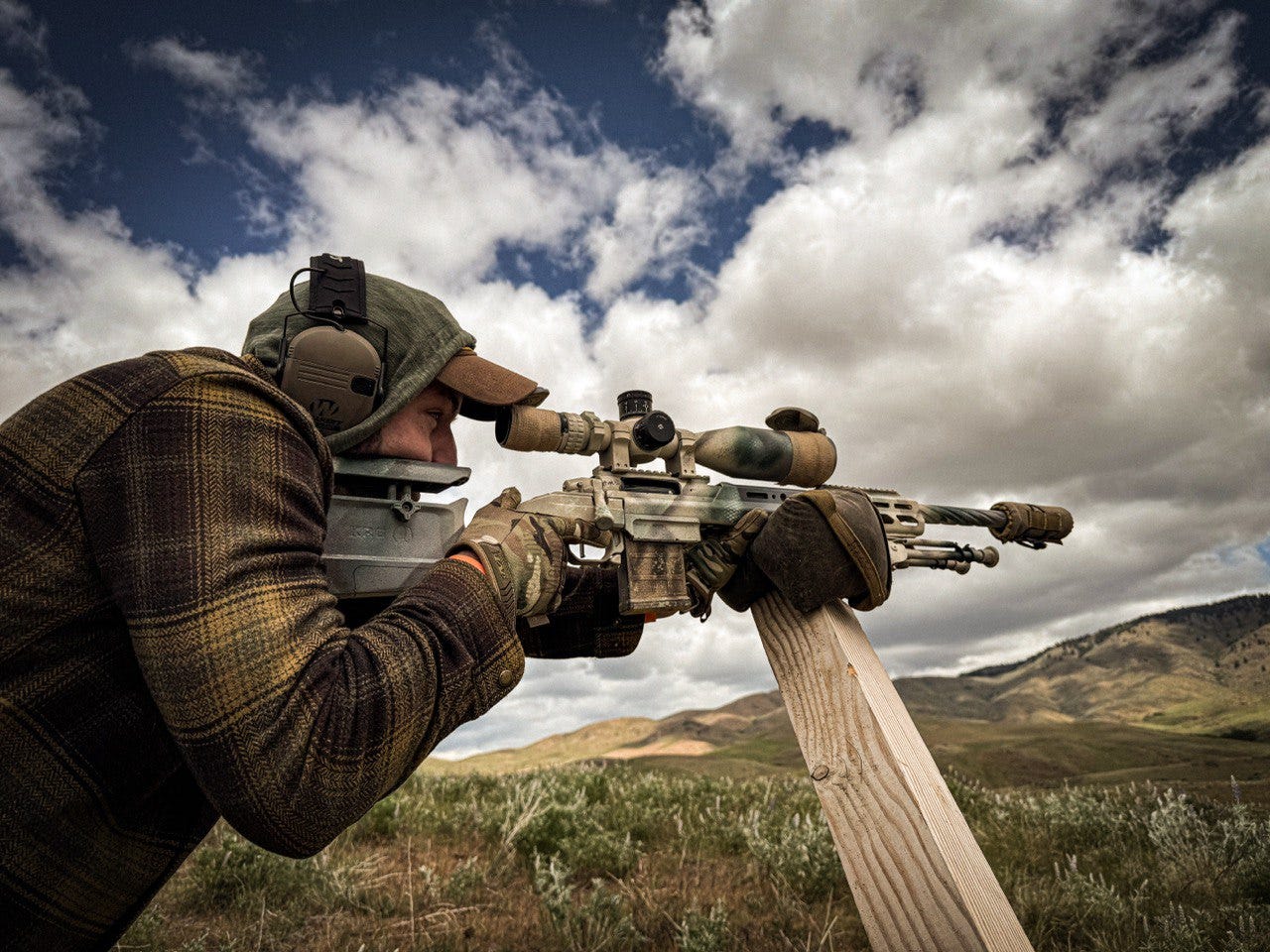
This last weekend, I had the privilege of attending a two-day precision rifle course taught by Adrian Leatherman of Sidewinder Concepts in the mountains of Idaho. It was one of those educational experiences that changes your thinking even beyond the scope of its domain (shooting). Scott, the organizer of the event, is particularly fond of Musashi’s saying that ‘he who knows the way broadly will see it in all things,’ and I felt that as a kind of epiphany out in the windy hills. I think this understanding is worth sharing... to whatever degree it is communicable.
Perhaps the most surprising part of the precision shooting world is (1) how many former law enforcement and military snipers there are there who (2) claim to have learned almost nothing of value during their service, and learned everything — or, almost everything — of value on the civilian side. Adrian himself was in this camp. Another participant in the course — a MARSOC sniper instructor — seemed to have retained more from his military training, but was still learning and adding to his already formidable skillset with civilian innovation.
My own background with shooting has been largely pheasant hunting. I got more into ARs in my later 20s and early 30s, and have acquired a few, but I had no real military experience or formal training with them, aside from basic instruction picked up from more experienced friends and acquaintances over the years. ARs are fun — I highly recommend them. For civil and self-defense purposes, they are probably the next most important firearm to own, besides a basic handgun like a Glock 19. I had picked up the long-distance bug in October of 2020, after getting my first spike elk on a hunt (also in Idaho) with my brother and father. One thing led to another, and after digging further into elk and deer hunting cartridges, the art of actually hitting the animals led me into the world of long-range shooting as its own, separate discipline.
Over the course of 2024, I constructed a custom precision rifle, with the intention of attending some PRS (precision rifle series) match events. But over the course of shooting discussions with some friends and acquaintances, one friend, Scott, decided to arrange a local(ish) course with Sidewinder as a sort of formal and proper introduction to the art. So off over the mountains I went, with another friend Jeremy.
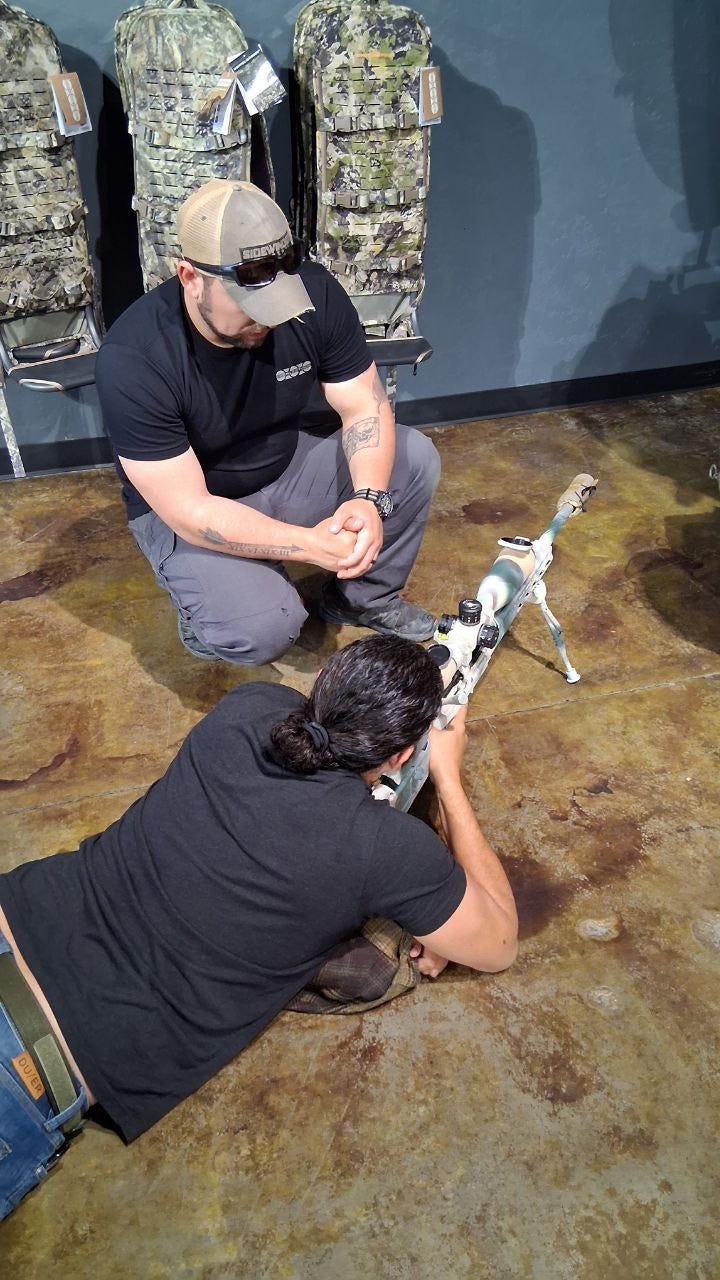
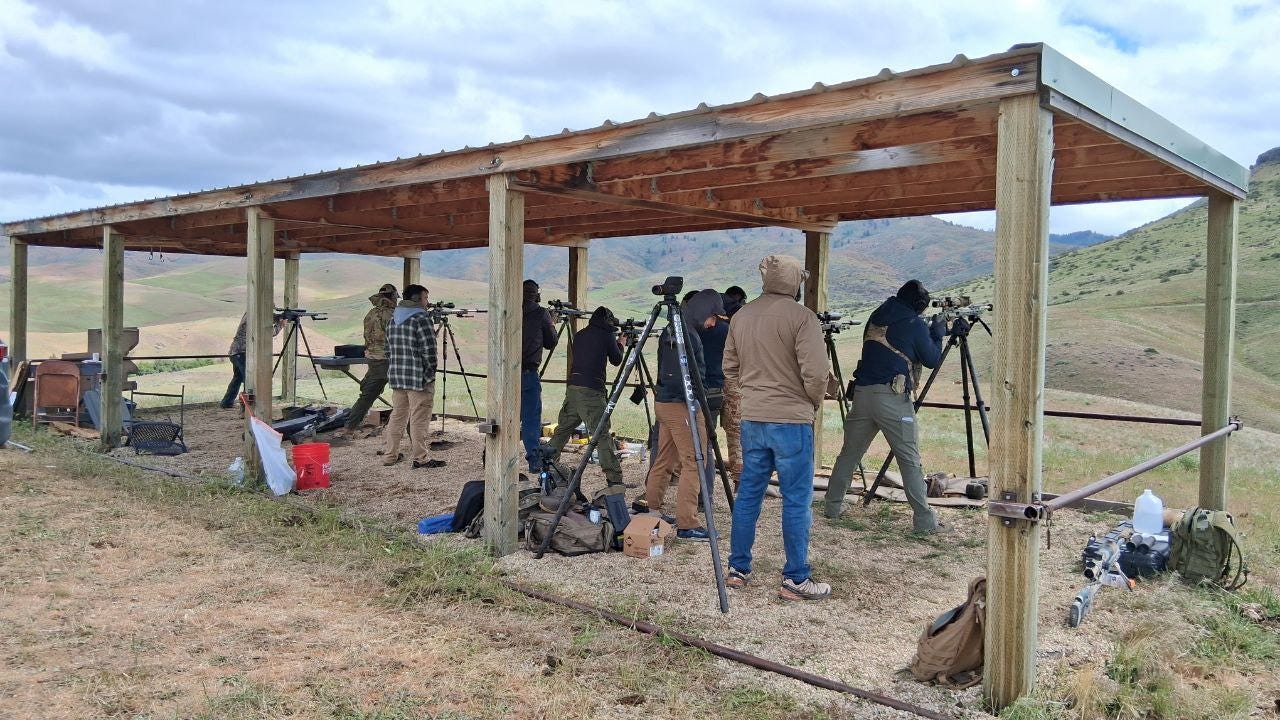
Adrian checking my friend Jeremy’s form
Taking in the Basics
The course began with five hours of classroom instruction, going over the fundamentals of proper form — length of pull, proper scope placement, “eye relief,” and so forth. Basically all of this could be boiled down to details in the application of geometry and body mechanics to make your body as solid and consistent as possible. Everything builds upon everything else, so if your rifle is set up wrong for your body, or if your body mechanics are wrong, everything else downstream from that is going to suffer. It’s all about stacking layers of consistency... not unlike the construction of the rifle itself.
In fact, maybe the most important principle to understand is that consistency and accuracy are synonyms. With consistency, accuracy is just a matter of of correction. Without consistency, accuracy is not possible.
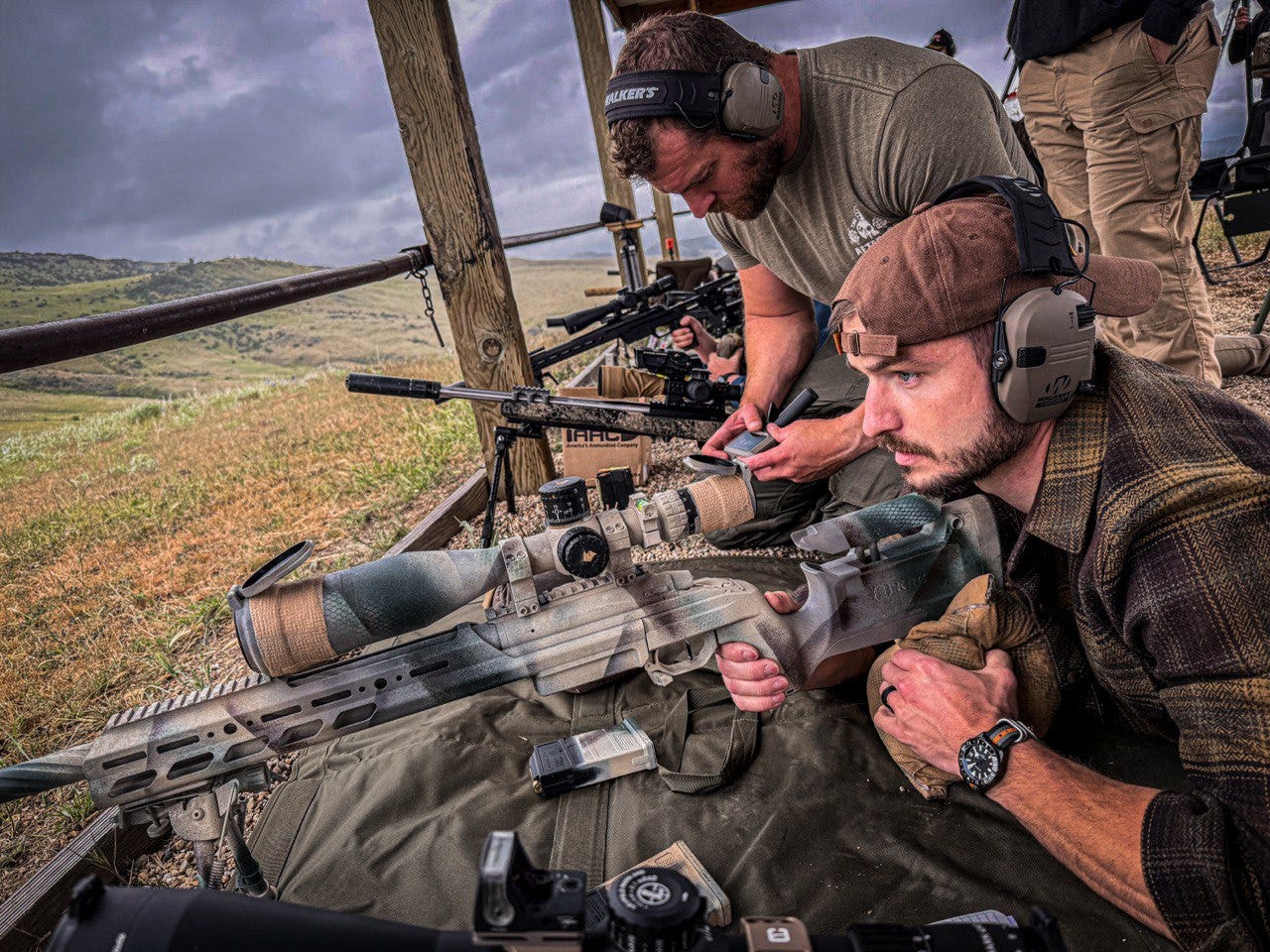
In the construction of a rifle, consistency is achieved by making the rifle — and especially the barrel — as rigid as possible. The barrel is usually thicker than a hunting rifle, so that temperature affects the movement of the barrel less. The bolt-action is popular because it has fewer moving parts, and so it tends be more consistent than semi-automatic rifles (at least, more consistent than affordable semi-automatic rifles). A good stock or chassis is chosen based on adjustability and rigidity, to reduce motion and increase comfort. The trigger should break at exactly the same weight, every time. And of course, there are bipods and optics to consider. Each of these are chosen with the same core idea: consistency, and features that aid in comfort, because comfort helps with... consistency.
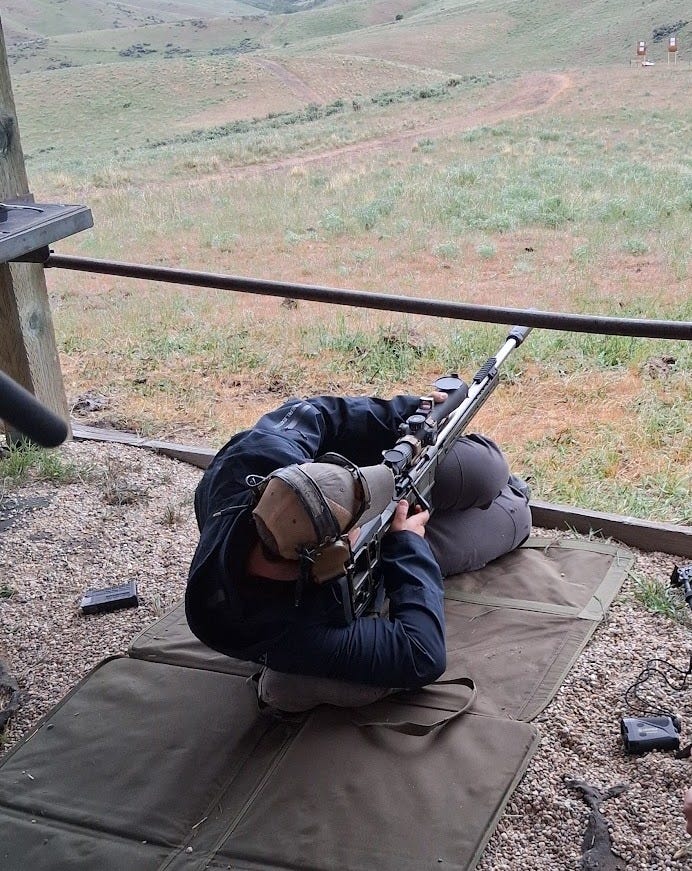
What we call “comfort” is actually, mostly, a matter of skeletal alignment. When our skeleton is supporting our body naturally, we don't have to use our muscles to maintain our position. Using our muscles creates strain, and ultimately, movement. Movement means inconsistency. So everything about “rifle yoga” — the squaring of the body, the raising of the shoulders to avoid crinking the neck, the alignment of the rifle with the spine, and everything else pertaining to correct posture — centers around this principle of structural rigidity, in the body as in the rifle itself. Comfort is not the goal; it just happens to be an incidental sign of bodily strength and proper alignment.
As someone with a background in martial arts, it was hard not to notice the crossover between body mechanics in martial arts and in shooting. Martial arts also utilizes body mechanics and alignment to generate stability and power. The primary difference is that in martial arts, your weapon is your body, and you use muscles to generate power. Stability is the foundation that allows you to generate power. In shooting, your power comes from a firearm. Stability is what allows you to direct that power with accuracy... which is to say, consistency.
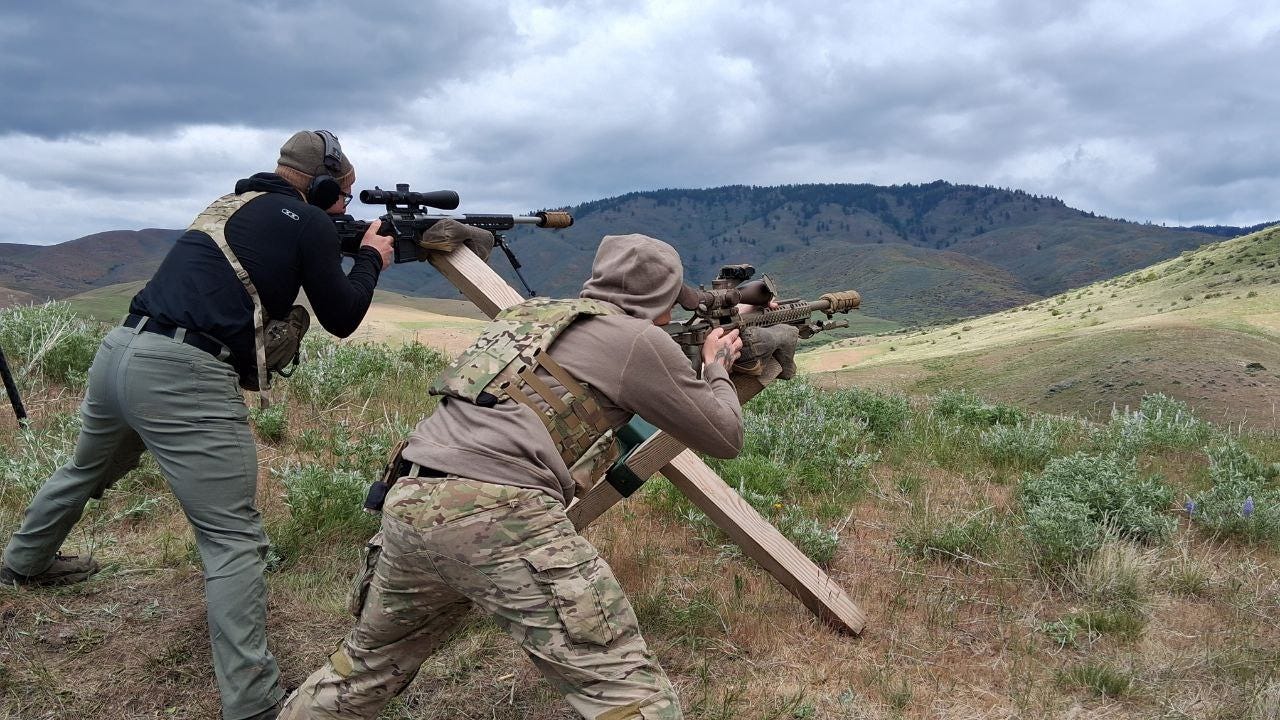
Out in the Hills
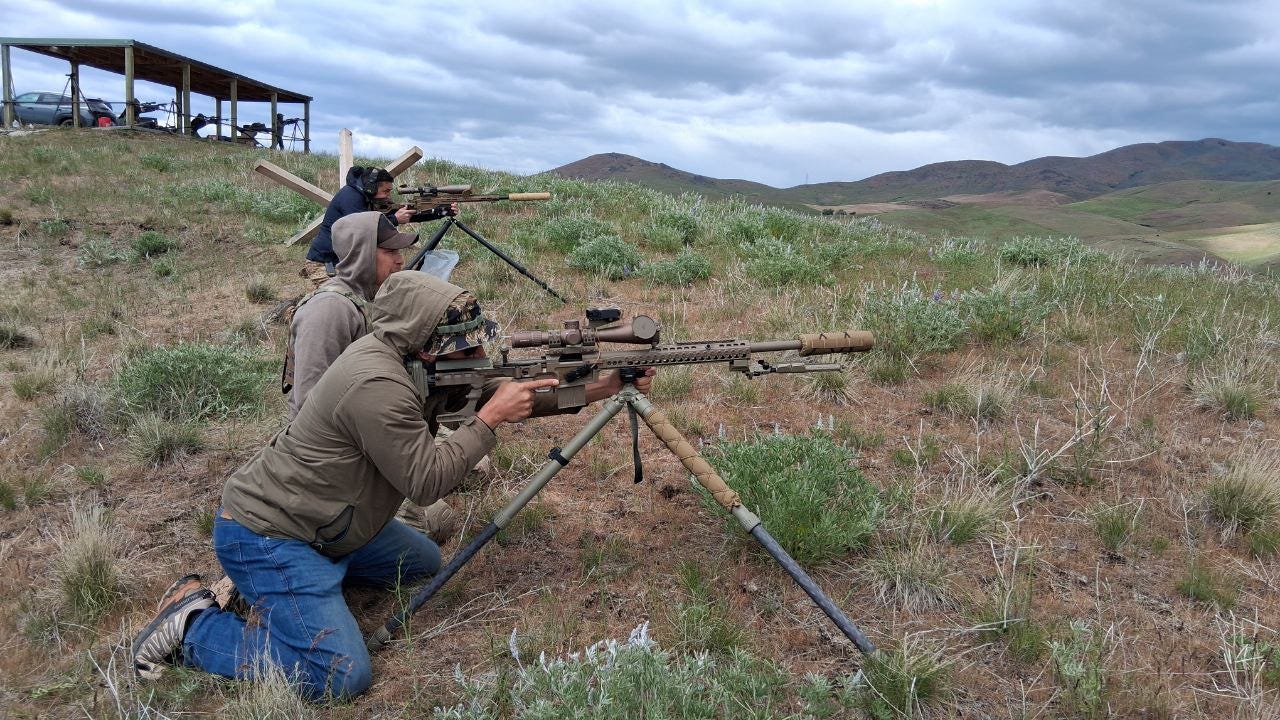
It's one thing to understand all these “principles,” and another to be able to apply them in practice. When there’s a dozen or so checkpoints to get right, it can become a challenge of memory and conscientiousness to do everything, even if every single component is easy by itself. The challenge of consistency becomes one of systematization, or ritualization; making a habit out of approaching everything the same way, lining yourself up the same way, putting your cheek on the riser the same way, pulling the trigger the same way, doing everything the same way. The impacts — or absence of impacts — are the check on your system.
Of course, not everything is about your body. That’s a big component, of course, but there’s also the data. Did you update your temperature and humidity numbers? Is your zero confirmed at this altitude? Did you swap ammo brands?
Maybe the most frustrating moments are when there’s a mechanical error; a screw coming loose on a bipod, or an optic. For the first 30 minutes or so at the range, I was feeling very dissatisfied with my zero (my rifle was printing 2 MOA groups — really subpar for a rifle of this style) when Adrian noticed that my suppressor had come loose. Thankfully, there hadn’t been any baffle strikes, but it was still enough to really mess with the rounds. After cranking it back down, everything was dialed back in to nice sub-MOA groups.
But the biggest, most difficult challenge with long-range shooting is... the wind.
Dealing with the wind is really the art side of precision shooting. You can use fancy equipment like kestrels and GPS data to try to get precise wind data, but usually that precision is actually an illusion. The wind isn’t usually doing the same thing the entire distance, between you and the target; sometimes, it isn’t even going the same direction. At one point, a few of the guys shooting out at the further distances (800 yards to 1000 yards) were noticing that while the wind was moving left-to-right from our position, they could see grass moving right-to left on the hill next to the target. Despite the distance, they made a judgment call, made zero wind adjustment, and hit the target.
It may sound odd, talking about judgment when basically everything else about shooting is about taking judgment out as much as possible. But the consistency in everything else is really what gives wind-calls any hope of being useful. Stacking judgment upon judgment, over distance, creates multiplying degrees of slop and error that just destroy any realistic hope of hitting anything really far away.
Now, it’s not as if judgment isn’t still at play in your system. There are thousands of great shooters out there, who are all nailing steel consistently at 800 yards and further, who all have different methods, different approaches, different strategies for how to make a shot. Some of it is different body styles (some people are bigger, some people are smaller, etc); some of it is just personal preference.
The reality, at the end of the day, is that judgment underlies everything here. The design and execution of your own system is all judgment — not just your sequence leading up to a shot, but the totality of your equipment choices, the standard you held yourself to during practice, the habit you made (or didn’t make) in practicing, and all the additional little X-factors that went into it along the way.
Maybe, in that regard, the judgment of the wind-call is the heart of the heart. The binary “ping” of a hit or dirt-splash of a miss is just the gauge of whether or not the thing we’ve built is working, or if we’re even holding to our own plan.
Shooting to Learn
There is a persistent kind of gallows-humor awareness of how expensive of a hobby long-distance shooting can be. It doesn’t have to be, but it often ends high up there with messing around with heli-skiing, scuba-diving, and boating, in terms of cost. Most of the rifles at the course were probably between $3,500 and $5,000. There was a decent stock Bergara with a Vortex Strike Eagle out at the course (a reasonable $2,200 set up, with the suppressor), but most of the rifles are much more. Among the students’ rifles were two Accuracy Internationals; for those, the chassis alone usually start at around $2,000. Optics can regularly run between $2,000 and $5,000. A good barreled action can be found for about $400, but most people wind up paying a lot more. Suppressors, tax stamps, expensive bipods, and you can very easily end up with a rifle that costs over $10,000. And that’s not including the tripods, the chronographs, the rangefinders, binoculars, shooting bags, and various, miscellaneous other gear that one just kind of accumulates over the course of a hobby.
And, of course, there’s the ammunition itself. Shooting thousands of rounds, at $1-$2 a round, can add up real quick.
What’s worth your money becomes its own judgment call.
Back home, I have a friend who shoots a Ruger American action in 6.5 Creedmoor. He mounted it in a Magpul Hunter stock, topped with a Monstrum G3 3-18x optic. The total cost of such a rifle is right around $900 — maybe a touch less. It’s not just at, but well below what most shooters would consider the bottom cost threshold of a precision rifle. But he regularly reaches out to a thousand yards with it, and beats people in PRS competitions with rifles 2-5x more expensive than his.
Is his Ruger American “just as good” as everyone else’s?
No. Not remotely.
But is it “good enough?”
A thousand yards is a thousand yards. Many people can’t make those hits, even with fancy, high-end gear. At the end of the day, it comes down to what you’re trying to get out of your gear. Do you want a bench-rifle for plinking? You probably don’t need to spend a fortune. Do you want military-grade resilience and night-vision capabilities? You almost certainly do need to spend a fortune. Do you want something that you can go hunting with? Very likely, you’ll want somewhere in the middle.
Do you want something that you hope will compensate for your lack of training?
No amount of money will wind up being quite enough.
...of course, good training isn’t cheap either.
Part-way through the course, as Adrian was explaining how it all comes back to fundamentals, he made a casual aside about how it was just like everything else. “It’s like talking to your wife, or your kids.” Adrian also made a few allusions to power-lifting, where proper form and structural alignment of the body can mean the difference between a strong lift and an injury. Form is key, both for building the right foundations as a beginner, and for getting the desired hypertrophy and avoiding catastrophic hospital visits at the more advanced levels. Relationships and lifting don’t have the initial overhead equipment cost that shooting has... but it’s not as though they can’t add up. Some relationships in particular can get very, very expensive.
But in terms of coming to “understand the way broadly,” I don’t think lifting, relationships, and shooting are equivalent. There is, I think, a danger in just diving in to a chaotic, multi-faceted field and expecting to learn by trial and error. Sometimes, of course, that's all we can do. But that approach lends itself to the laying of weak foundations, and the development of bad habits. It would seem that for the sake of building systems and developing one's sense of “the way,” the best place to learn how to learn is not the chaos of life, but the more controlled — and controllable — domain of the gun.
Of course, most of this art comes from the profoundly chaotic world of war. The more-or-less scientific approach to the development of a skill is not meant as some kind of spiritual escape from chaos, but the development and refinement of a pragmatic tool, so that we can go into the chaos of life — whether that's the fog of war, or a rainy mountain in pursuit of some animal, or something beyond shooting, like a relationship — with dependable skills. Long range shooting just lends itself to the development of this skill of development better than most.
Is it worth the money?
The odds that you will need to engage targets at distance, like a sniper or a designated marksman, are pretty slim. Even in most hunting trips, the animals are under 200y. But the odds that one will apply this approach to learning, more broadly, is — or should be — 100%, in one's business, finances, relationships, health, and everything else.
And there is something special about shooting specifically, for men, that carries the emotional import of life-and-death, like a sort of blood memory from times when putting food on the table might come down to being able to put an arrow in a deer at a fairly good distance. Could we learn this zen-like detached approach of refinement in other domains? Of course. Theoretically. But it seems harder to get invested. Men are naturally drawn to violence in general, and to shooting specifically. It is a part of us that attracts us more than, say, excel spreadsheets or insurance law.
At the end of the day, shooting is a martial art. While we use it for competitive sport and for hunting, the motivation behind the development and refinement of the art is combat, just as the ultimate motivation behind Karate, Boxing, and Brazilian Jiu-Jitsu is not exercise, camaraderie, or ‘the culture,’ but an improved ability to kill another person. Behind each martial art is death. And of all martial arts out there, none is more lethal than shooting. That doesn’t mean to get into shooting so that you can shoot someone, any more than one should get into boxing so that you can punch someone to death; it’s about what draws us into the learning of an art, and teaches us how to refine our own learning processes.
In that regard, I found long-distance shooting to be uniquely transformative. It is as humbling as it is rewarding.
Perhaps it isn’t for everyone. But it’s definitely something I’d recommend more people try — not as a casual hobby, but as serious martial art and an education in attention to your own body.
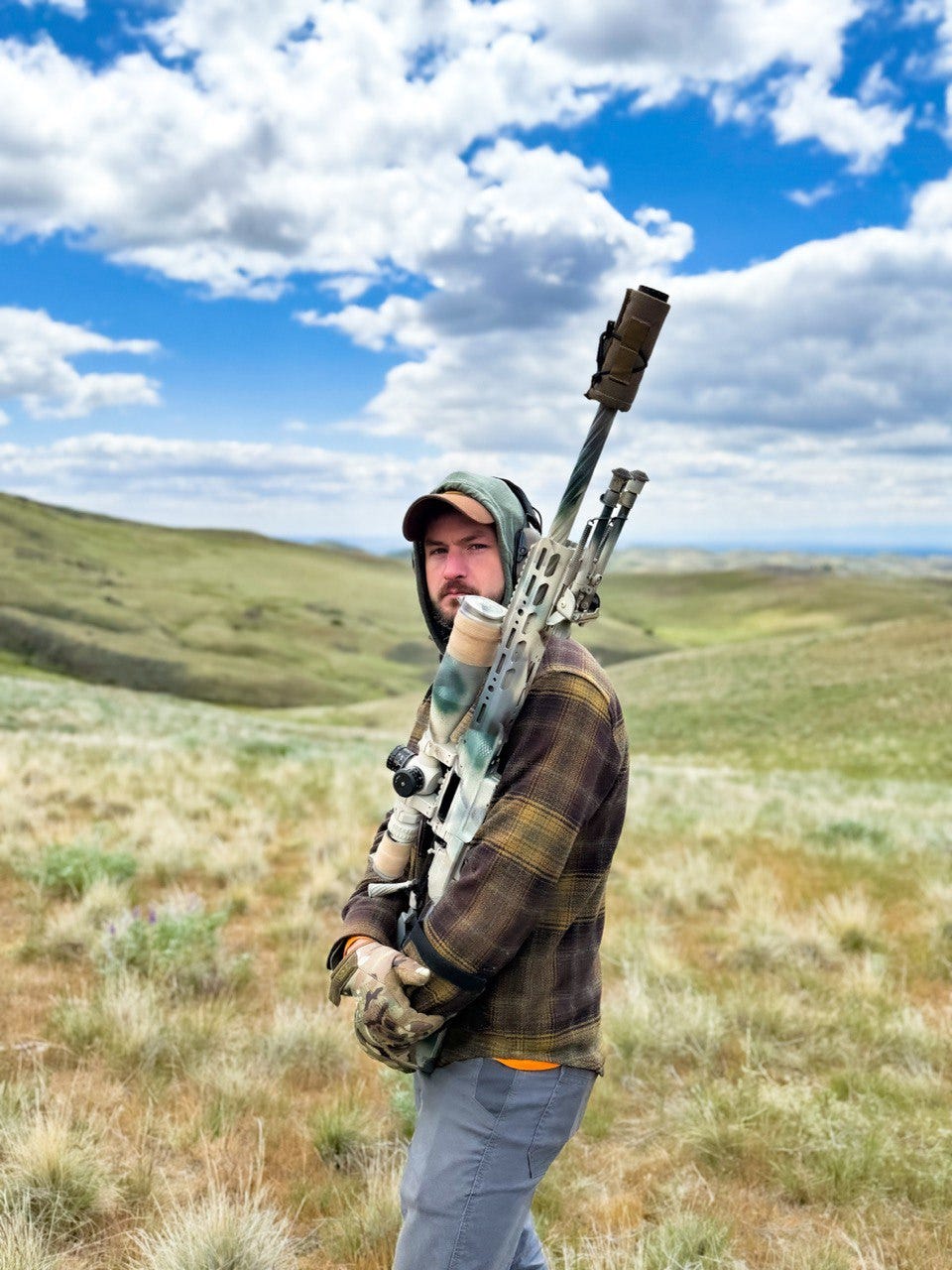
I've done a decent amount of shooting and gun training, but I find the long distance stuff to be the most fun by a long shot! Nothing like the plink of steel at 880 yards! (Farthest I've shot)
I'm fortunate to have a good friend who's a PRS competitor and has shown me the ropes, though the cost of the hobby keeps me from getting too invested myself.
This friend refers to long distance shooting as "weaponised math" and "like golf, but for men" both of which I find quite appropriate.