
The Negative Case for Virtue Ethics
Making morality about yourself again

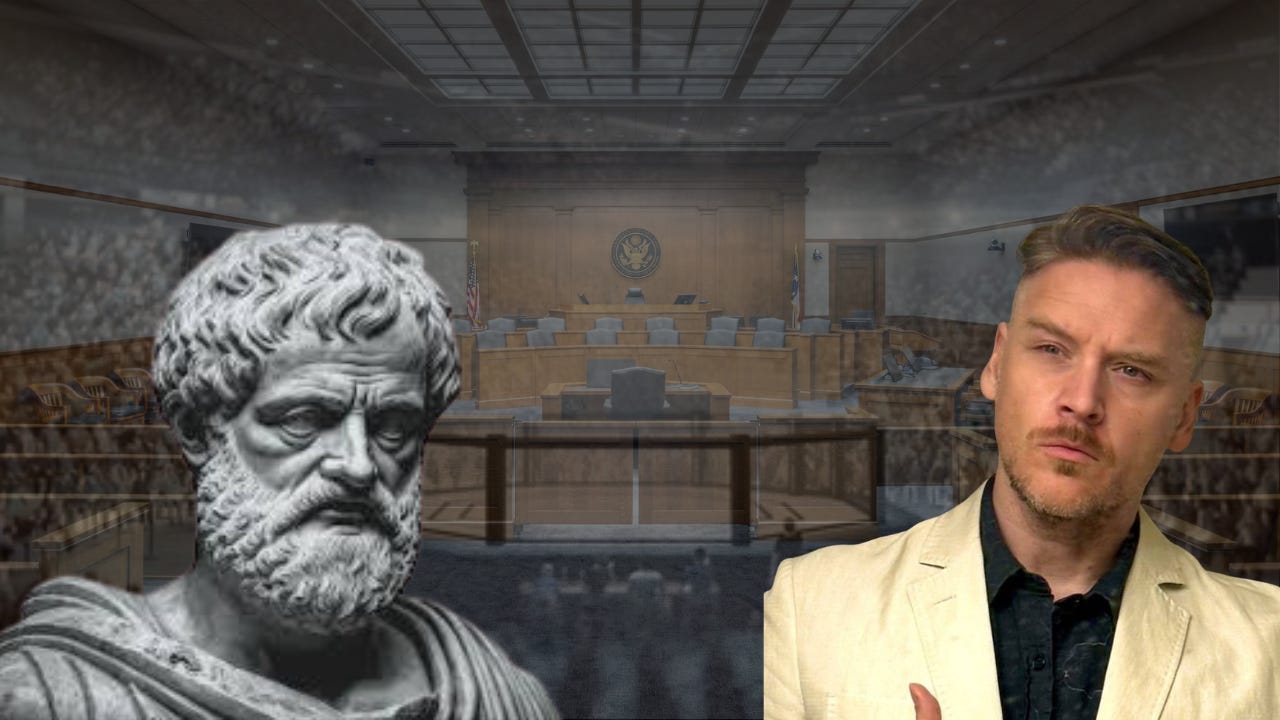
It seems that one of the persistent criticisms of virtue ethics as a moral system is that it doesn’t give clear, concrete answers to particular moral questions.
Is abortion permissible? How about capital punishment?
Divine command theory gives an answer.
Deontology gives an answer.
Utilitarianism gives an answer.
What that answer is matters less than the feeling of clarity in there being an answer. We will of course observe that advocates of each of these systems still disagree with each other, as in, one Divine Command theorist will say capital punishment is permissible, while another disagrees. But both agree that there is an answer, and that if only we look hard enough at the framework and the facts, we can find the answer.
Virtue ethics, by contrast, does not promise answers — at least, not in itself. Whereas Divine command appeals to the gods, Utilitarianism to pleasure, and Deontology to the necessary logic of morality itself, Virtue ethics just kind of vaguely gestures toward the “virtuous man” as the arbiter. There is an assumption that there are really no “rules” that don’t come with exceptions, and it takes virtue (which here just means ‘excellence’ in disposition and knowledge) to see and follow the best course of action, in any given case. It’s a beautiful and functional way to live, but a somewhat unsatisfying framework to appeal to in discreet cases.
But perhaps this too is a strength?
I have noticed in recent years that one can think of “morality” in essentially two different modes: (1) as a framework for living and choosing how to act, and (2) as a framework for condemning other people. Jack Donovan and I discussed this a little bit when we were talking about moral reasoning a few weeks ago. Much of what interests people in “morality” these days is actually the second of these. Indeed, much of the attraction to the Orthodox Christian version of deontology (as championed by Jay Dyer and Andrew Wilson) is explicitly this: how do I condemn someone if I don’t have an objective and coherent moral framework? The subsequent meta-ethical “debates” with outsiders are, at their peak, humiliation rituals for those outside the logic circle, basically rubbing the bewildered adversaries’ noses in the lack of justification for their own moral beliefs.
But when we look at these “debates,” something feels distinctly amoral about them, or perhaps even immoral. It doesn’t seem as if we are living — or speaking — in a morally superior fashion, on the other side of all this moral study, when the purpose is to condemn.
This is not to say that we should not condemn — we absolutely should. Some people act grotesquely immorally, and a just society requires that such acts be condemned. But the deontologists act as if a condemnation is not possible without a logical-coherence framework (the history of humanity is evidence to the contrary), or as if a logical-coherence framework provides an ounce of additional weight to the desired condemnation (it doesn’t, for the same reason). Their opponents are not relativists anyway — broadly speaking, they are utilitarians.
Ironically, utilitarians often make the same mistake. Sam Harris — with his Masters degree in philosophy — got up on stage and said that if you don’t think morality is about utility, then he doesn’t know what you’re talking about.
What this looks like is two equivalently political sides (deontologists on the right, utilitarians on the left), imagining that they are speaking for the Only True Morality against bias and whim. The other side is bigotry or sloth and envy, wrapped up in moralistic rationalization, and we need hard, objective moral theory to justify a condemnation of evil. But in both cases, this manifests as a moral philosophy that is less constructed around choosing a better life, and is more devoted to the task of condemnation. The result, of course, is a race-to-the-bottom in adversarial debate, masquerading as morality in thinner and thinner masks of righteousness.
For this reason, the fact that virtue ethics does not offer very clear or direct answers to particular moral questions may actually be a blessing, and not a curse. The supposed ability of other moral theories to systematically answer precise moral questions — or to condemn those who answer them in the wrong way, from an ‘objective’ framework — may not be a benefit of a moral theory, but a sort of curse which draws the moral system into partisan conflict, rather than — and at the cost of — living a better life. Insofar as morality concerns right action, then the proper framework for judging a moral theory is not its ability to condemn others, but its ability to improve one’s own life. And on this point, virtue ethics remains unsurpassed.
Again, this is not to say that we should not condemn or debate. We absolutely should. But in doing so, we should be exceptionally careful in not transforming our own moral systems on the basis of what is most useful in condemnation, or we might — as Nietzsche warns against — become a monster in our pursuit of slaying monsters. Toward the end of not becoming a tunnel-visioned, moralizing moral monster, the ambiguity of virtue ethics may be understood as a virtue of the theory, and not a shortcoming. That it is less useful in internet blood-sports style debate may be a symptom of its superiority as a way of living, and not evidence of its inferiority on account of it being less powerful in adversarial debate.
Wow, this really clarifies some things for me. Where I struggled with virtue ethics is just this- that there is no objective way of measuring intent, so what happens in the case of bad unintended consequences of virtuously intended actions?
But as you explain, there’s no need for that objective measurement. Virtue ethics is a guide for ME to try to do the right thing while knowing the consequences and perceptions are out of my control.
Excellent essay! Thanks!
I see your point that Virtue Ethics doesn't give a framework, or a strong one, for condemnation. In a way, it does feel the point of it. Virtue Ethics is about developing excellence of character, and the latter clearly has a cultural dimension. However, under this pretense, there can be agreements on the moral requirements that are needed for everyone to have the opportunity to develop virtue in character.
In a way, Virtue Ethics could be the only one that requires freedom, as in other ethics freedoms are more of a "trade-off"; virtue ethics needs freedom to prosper.
Sadly, I feel it is easy in the culture to go misinterpret having personal freedom as to not having "responsibilities towards society" which ironically may signal lack of virtue. This seems another large limitation of the adoption of virtue ethics. You need virtuous people for it to work well for society.