
Translation Politics
How we might have gone wrong in ditching Greek and Latin...

If there is one thing I have learned in debating with professors and academics over the past three weeks, it is that expertise in a foreign language by no means guarantees a correct translation. The translator brings all their assumptions (moral, political, and personal) into how they see and think of the words in front of them. In today’s climate, some of these assumptions become so brazen that the translation can go from merely misleading to downright wrong.
Earlier today, I found myself arguing with a woman named Liv Albert, who interpreted Odyssey 9.19-20 as “my name is Odysseus, I’m famous for my lies.”
The Greek line is:
εἴμ᾽ Ὀδυσεὺς Λαερτιάδης, ὃς πᾶσι δόλοισιν
ἀνθρώποισι μέλω, καί μευ κλέος οὐρανὸν ἵκει.
Which we could translate literally as:
I am Odysseus, son of Laertes, who is known to all men for my cunning stratagems (δόλος), and my fame reaches to heaven.
The critical word is dólos, which can mean “bait” or “snare,” and the verb conjugation dólou can be understood as “beguiling” or “taking by craft.” Although this “guile” or “craft” extends beyond lying, it also encompasses lying and deception, meaning that while “lying” might be a somewhat limited translation, it appears to be at least a valid and plausible translation of dolos... right?
Besides, it’s not like Odysseus doesn’t lie...
The context of this opening section of Book 9 is a carrying forward from the ending of Book 8, where Demodocus the bard is singing of the Trojan war, including the famous Trojan horse (8.493, 511-513). Indeed, when Odysseus is asking for Demodocus to sing of the horse, he even describes the horse as dólon in 8.494. And when Demodocus is introduced, he is described by Homer as “...sing[ing] the famous actions (κλέα) of men on that venture, whose fame goes up into the wide heaven...” (8.74-75).
Indeed, we see a nearly precise repetition of the phrase kléos ouranòn from 8.75 -- “fame [reaching] heaven” where the Phaeacians do not yet know Odysseus’ identity, in 9.20, when Odysseus is identifying himself as Odysseus, using the language that described the heroes of Troy (including Odysseus himself) and of the Trojan horse. Odysseus is saying “I am the man you were singing of...”
Aside from the poetic symmetry, we are illuminated to the meaning of dólos by this symmetry; it is referring to the Trojan horse. Odysseus is saying “I was the mastermind behind that strategy.”
Now, in a sense, we could say that the Trojan Horse is a “lie”; Sun Tzu famously argued that “all warfare is based on deception,” and in this sense -- as with camouflage uniforms, operational security, and decoy maneuvers to protect your soldiers -- the Trojan Horse was, indeed, a deception. But if we are to translate MARPAT camouflage as a “lie,” we ought to distinguish this sort of military-tactical lie from the kind of lie that we associate with interpersonal dishonesty, and not multiply instances of the latter by conflation with the former.
Beyond the most technical of linguistic possibilities, dolos does not mean “lying”. A military tactic and a false narration are not lies in the same sense. In Greek, it is not the same word (we might look for something related to pseũdos), and in either language, they are not the same concept. When Odysseus introduces himself as the man from Troy, he is -- according to Homer -- telling the truth (which we can’t say in 24.303-304, where polymetis Odysseus says he will tell the complete truth, and then gives a false identity and story; polymetis does not mean “lying,” it at least precedes a lie, in speaking with Laertes; here, perhaps Wilson’s choice makes a kind of sense). His choice in language in the beginning of Book 9 is not primarily about describing or praising himself, but in repeating the language from the previous book to emphasize the sameness of the character in Demodocus’ song and himself.
With Wilson and Albert, the question really becomes: why are we trying to make him a “liar”? More precisely, why are they choosing to translate words like polymetis and doloisin as “lying,” when that is not what they mean?
One of my own great struggles with translation has been trying to get into the mindset of the past. It has been said that “to learn another language is to grow another soul;” I suspect that there is some hyperbole in this, but we certainly come to know other minds -- other souls, through language. One must set aside one’s own biases and interpretive frames (as best as one can, since completely doing so is impossible), and try to see what the text is saying on its own terms.
There is no real way to arrive at “lies” or “lying” from dolos in this way. Such a translation or interpretation is a symptom of moral (and perhaps political) prejudice that seeks out a condemnation of the male protagonist. This is not to say that Odysseus does not lie, but the tragic result of this political frame is that it will cause the reader to miss the beautiful symmetry that we see in the language between books 8 and 9, just as the people who interpret Achilles’ and Patrokles’ relationship as homosexual causes them to miss out the far more powerful connection between Achilles and his love of glory (the name Patrokles means “glory of the fathers,” via pater - kleos). Political and moral biases flatten the texts and make them more shallow. And this flattening isn’t just a Greek matter.
I have come to wonder if we have collectively missed out on something, in ditching Greek and Latin in school for STEM (science, technology, engineering, and mathematics), and other “practical” things. We complain a lot about the “polarization” of politics, but so much of that polarization is a complete inability to understand how other people might think which parallels the difficulties in translation that we keep seeing in modern attempts at “reimagining” and “re-telling” the Greek. What I have observed is that the people who are likely to mistranslate a word like doloisin from Greek into English are the same sorts of people who are likely to misinterpret a scholarly disagreement over a literature passage as “sexism.”
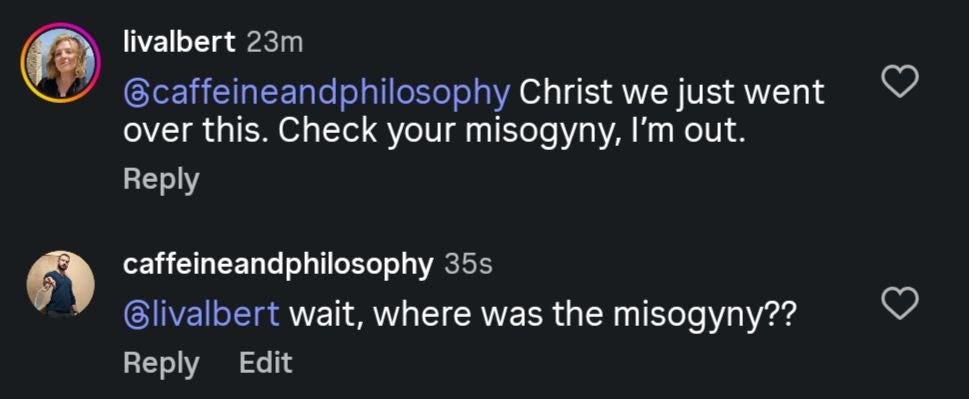
I don’t believe this similarity is a coincidence. I am convinced that the skill of translation, of slow exploration, looking at things from different angles, and setting aside one’s own moral and political identity while attempting to understand something, is a powerful skill that can, in fact, be developed through translation; by looking into old texts -- from people in another place and another time -- and turning that into English as best we can. I think abandoning the development of this skill in childhood (late middle school, and high school), prior to development of a more or less rigid moral and political self-conception, has inhibited the development of the very skill which is necessary for communication across political, ideological, religious, and moral divides. In place of something like real empathy, curiosity, and openness, we have created theoretical models that caricature how others think: “the fool says in his heart, ‘there is no God’,” thus we need never listen to anyone who disagrees with our notion of God, because he is a fool! And anyone who disagrees with Wilson obviously only does so because they hate women, etc.
Wilson herself is, of course, a possible counter-point to this, having herself learned Greek at a relatively young age. But I still hold that an exception does not prove a general rule, and even skill sets inclined toward the kind of open curiosity we are aspiring toward can be used for ideological abuse in a cultural climate which has become dominated by politics, under the doctrine that “the personal is political.” It is possible that the obsession with the “practicality” of STEM reflects a failure to appreciate the social (and ultimately, economic) importance of social connection and understanding that we move towards through translation across time. And maybe returning to Greek and Latin in high school might be a small move in the direction of the kinds of virtues and skills that can help us all move collectively past the political and moral impasse we have found ourselves in, of which mistranslations of Homer -- and mischaracterizations of English -- are a symptom.
Naturally -- as I must begrudgingly acknowledge, from these very debates with so-called “experts” -- translation knowledge clearly does not cure this intractable problem. But in conjunction with some basic philosophical training, it might be a step on a path back toward something like social reasonability and mutual comprehension, in a world that is literally dying over straw men.
Anyone chatting with Flint Dribble is a lost cause. I joked in my head that all she was missing was the nose ring - til I focused a little more and realized it was already there.