
Mapping Moral Thought
A quick reference-guide to moral philosophy

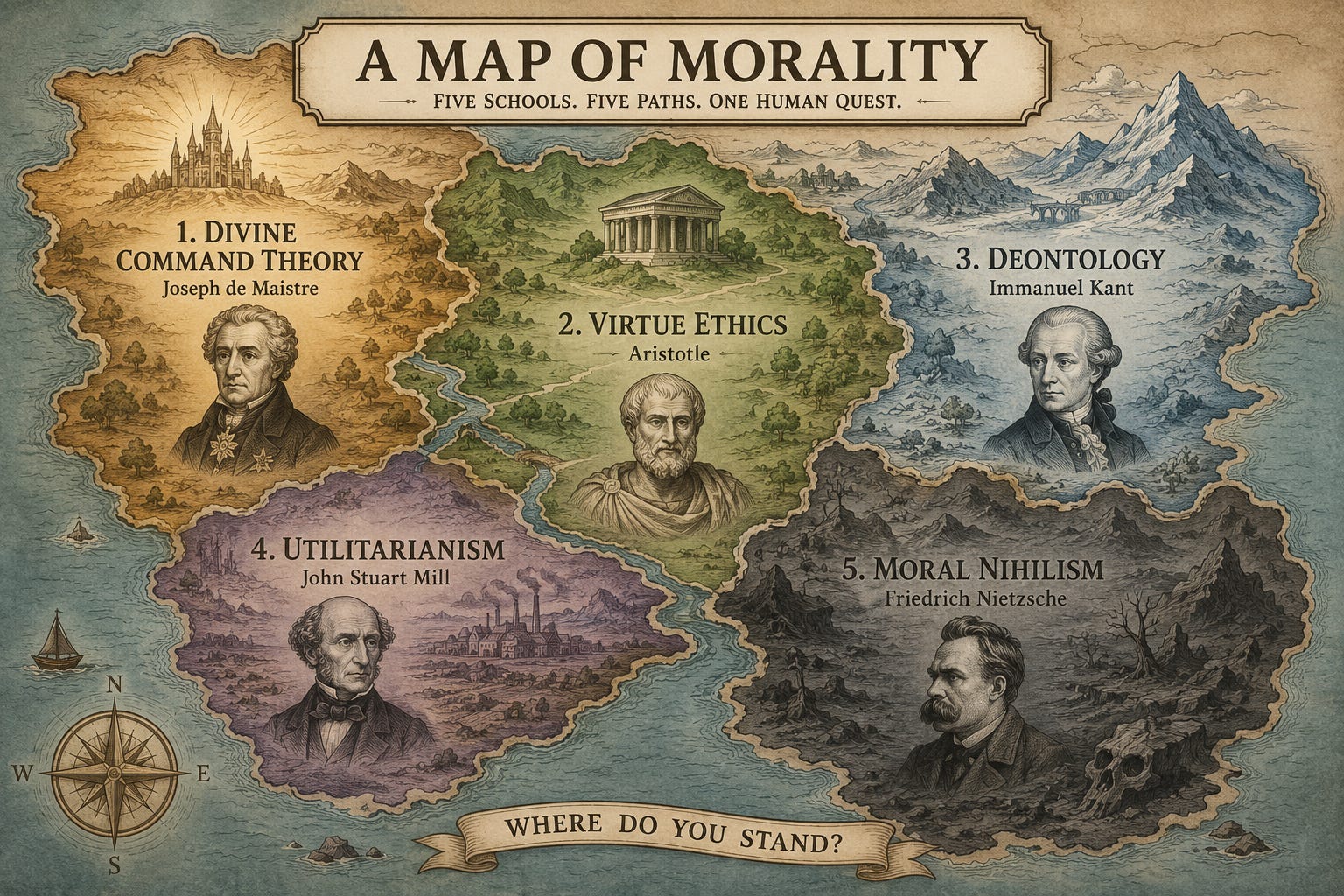
After making a negative case for virtue ethics — as well as a longer, positive case for virtue ethics in relation to AI — I was recently asked if I could give a broader overview of the major theories of moral philosophy. Here, I will try to give a quick overview of what I consider to be the 5 major schools of moral thought — what they are, who they came from, their strengths, their weaknesses, and sort of where they sit in contemporary moral philosophy.
Let us dive in, in rough chronological order.
Divine Command Theory
Divine Command theory (henceforth “D.C.T.”) is the oldest moral theory. Preceding writing itself — let alone philosophy — D.C.T. does not have an originating thinker, although it has a number of prominent defenders against alternative theories, the most powerful probably being the French Catholic philosopher Joseph de Maistre.
D.C.T. argues that morality comes from God, or the Gods. Any moral ideas that come from humans are subject to the corruption of human desires, when they are not those very desires themselves disguised in moralizing language. If morality exists at all, it must come from some source above humanity. This source is divinity — the gods, or God.
Strengths
D.C.T. provides both moral clarity and social unity, especially when a society is united in religious belief. There are also psychological benefits to religious belief that are not easily separated from the moral theory that is contingent upon this supernatural belief.
Weaknesses
D.C.T. is subject to the Euthyphro problem, which asks “what’s moral when different Gods want different things?” Even if one supposes there to be only one God, the question still — in principle — separates morality from the will of God. There are also philosophical challenges to the existence of God.
Virtue Ethics
Virtue Ethics (V.E.) was advanced in a sort of early form by Plato, but distilled and is generally considered to be the creation of Aristotle, especially in his Nichomachean Ethics.
V.E. holds that moral action can’t be determined by some system, but good moral decisions are made by excellent men. “Virtue,” here, is just a synonym for excellence. So one pursues excellence, and in doing so develops character. Character means you have a large body of experience with things, and have made a habit out of good and excellent decision-making. From this combination of experience and habit, you will be well-positioned to make good decisions in general, and good moral decisions in particular.
Strengths
V.E. is arguably the most individually actionable of the theories. It also escapes all of the tricky conundrums that plague the systematic schools of morality, like D.C.T., Deontology, and Utilitarianism.
Weaknesses
Insofar as morality is both social in nature and is also arbitrated socially, V.E. is very difficult to use as a justification for any decision. For similar reasons, VE not only doesn’t provide much in the way of moral clarity, but often doesn’t even really provide moral answers to specific questions.
Deontology
Deontology (sometimes called “transcendentalism”) comes from the German philosopher Immanuel Kant, who argued that in order for morality to be itself, it cannot have anything to do with consequences. Acts are either good in themselves or bad in themselves. The word deontology describes “duties,” and deontology argues that morality really concerns duties to particular kinds of behavior, in more or less absolute terms. According to Kant, for example, it is never permissible to lie, because the act of lying is wrong.
Strengths
“Moral clarity” might be an understatement here. Socially speaking, deontology is also phenomenal at winning debates.
Weaknesses
Deontology is completely impractical, and functionally speaking nobody actually lives this way. Philosophically, it also falls prey to a variety of different conundrums, pointing out cases where following deontological principles violate clear moral intuitions (the “Nazis at the door” thought experiment, for example, where lying to save a friend seems moral).
Utilitarianism
Utilitarianism originally comes from the English philosopher Jeremy Bentham, but was refined by John Stuart Mill — who is often credited as its “creator.” Utilitarianism is essentially the opposite of deontology, holding that morality concerns consequences. Specifically, utilitarians care about positive utility (pleasure) and negative utility (pain). What creates more pleasure for the most people (or conscious creatures), or, perhaps more importantly, what reduces suffering for the most people, is what is most moral.
Strengths
Not only is utilitarianism fundamentally simple and clear, but offers the tantalizing promise of something quantifiable. For this reason, utilitarianism lends itself nicely to systems of all kinds, and also to more naturally to accountability.
Weaknesses.
Aside from the difficulty in achieving the promised quantifiability, utilitarianism suffers from a similar slough of conundrums pitting utilitarian logic against moral intuitions — the infamous “trolley problem” being one of the most popular ones. There is also a more fundamental problem in associating morality with pain and pleasure if one views these as signals, rather than merely as states of being with no instrumental meaning — such an interpretation of pain or pleasure would point to purpose for which “utility” is instrumental, and therefore utility could not be the basis of morality.
Moral Nihilism
Moral Nihilism (M.N.) can largely credited to the work of Friedrich Nietzsche. MH is not the same as nihilism or cynicism; it does not reject values, but specifically rejects moral values as conflicting with — or, at least, having nothing to do with — what one might call “real” values.
In some formulations (Nietzsche’s) M.N. argues that what we call “morality” actually begins as a response to success, health, and happiness, making morality not just misguided, but closer to something like evil. In other formulations, morality is held to be simply incoherent (J.L. Mackie).
Strengths
M.N. is a philosophically simple and strong position (building its own strength upon the weaknesses of the other moral systems).
Weaknesses
Aside from M.N. not being especially actionable, it has a very difficult time explaining the ubiquity of certain moral intuitions.
The purpose of quickly mapping out these schools of moral thought is in identifying which frame someone is arguing when they present an argument that such-and-such is “morally wrong.” Such an argument can theoretically be made purely on the basis of moral intuition alone (as in, that seems wrong), but those same moral intuitions also usually grant that sometimes, a correct moral action in context is sometimes counter-intuitive, especially to an outside viewer who does not have all of the relevant information (as Yaweh argues at some length in Job 38-42).
But if two interlocuters are in agreement on values and on general moral frame, it can turn moral debates from a kind of social scolding contest into something more productive in the improvement of our lives or conditions, which was what morality (perhaps) used to be about.
This is the best summary for the different moral theories, thank you very much for this and thanks for your effort
This could be used as a cheat sheet. So simple and clear.